

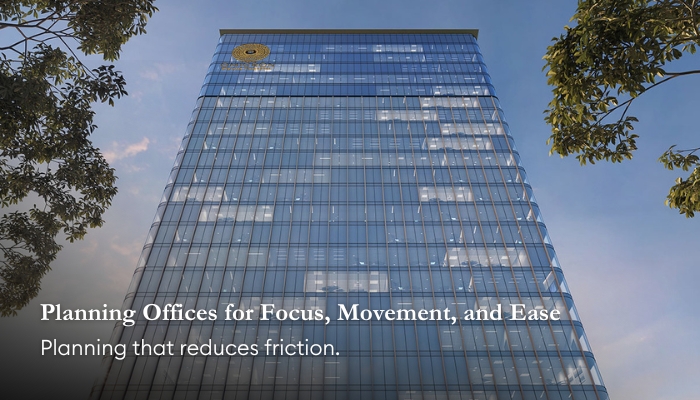
Planning Offices for Focus, Movement, and Ease
Introduction The way commercial spaces are planned today goes beyond desks and meeting rooms. It impacts how people think, move, interact, and ultimately perform through a workday. Thoughtful planning is not an aesthetic afterthought. It is a strategic foundation that supports productivity, clarity, and a sense of calm in the workplace. 1. Light, Comfort, and Spatial Quality Natural light, ventilation, and overall comfort are not incidental to productivity. They are fundamental. A well-planned office ensures daylight reaches deep into the floor plate and that air movement is unobstructed. These factors help reduce fatigue, support concentration, and foster a working rhythm that feels organic rather than forced. When people feel physically comfortable, they can give their attention fully to their work. Where there is glare, heat buildup, or stagnant air, even the best intentions get interrupted. 2. Intuitive Circulation and Movement An office must move as smoothly as the people who use it. Circulation planning, zoning of functions and logical placement of amenities reduce friction. Poorly resolved circulation leads to unnecessary movement, cognitive interruptions, and a persistent undercurrent of inefficiency. Effective circulation connects people to the spaces they need—workstations, collaboration areas, meeting rooms and services—with clarity. It eliminates confusion and subtly reinforces a sense of order in daily work patterns. 3. Supporting Diverse Work Modes Work is not singular. It alternates between focus, collaboration, discussion, review and pause. A productive office responds to these different modes with spatial variety. Quiet zones allow deep focus. Structured collaboration areas invite dialogue. Simple, calm break spaces offer pause without distraction. This calibrated variety encourages both concentration and connectivity. People choose the space that suits the task, rather than being constrained by one uniform environment. 4. Reliable Infrastructure and Everyday Ease Beyond spatial planning, the everyday efficiency of a workspace rests on reliable building systems and thoughtful provisions. Smooth vertical circulation, stable power supply, clear signage, adequate parking and comfortable common areas all contribute to a sense of ease. When these fundamentals work without friction, people are free to focus on performance rather than logistics.Productivity is not merely a function of tools, targets or policies. It begins with space that is aware of how people actually move, interact and work. Good planning accommodates light, simplifies movement and supports a range of work behaviours. In such spaces, productivity is a natural outcome—not a pressured goal. In commercial real estate, where long-term performance and tenant satisfaction matter, the quality of planning is as important as location or cost. An office that favors ease, clarity and human comfort ultimately elevates the way work happens within it.